

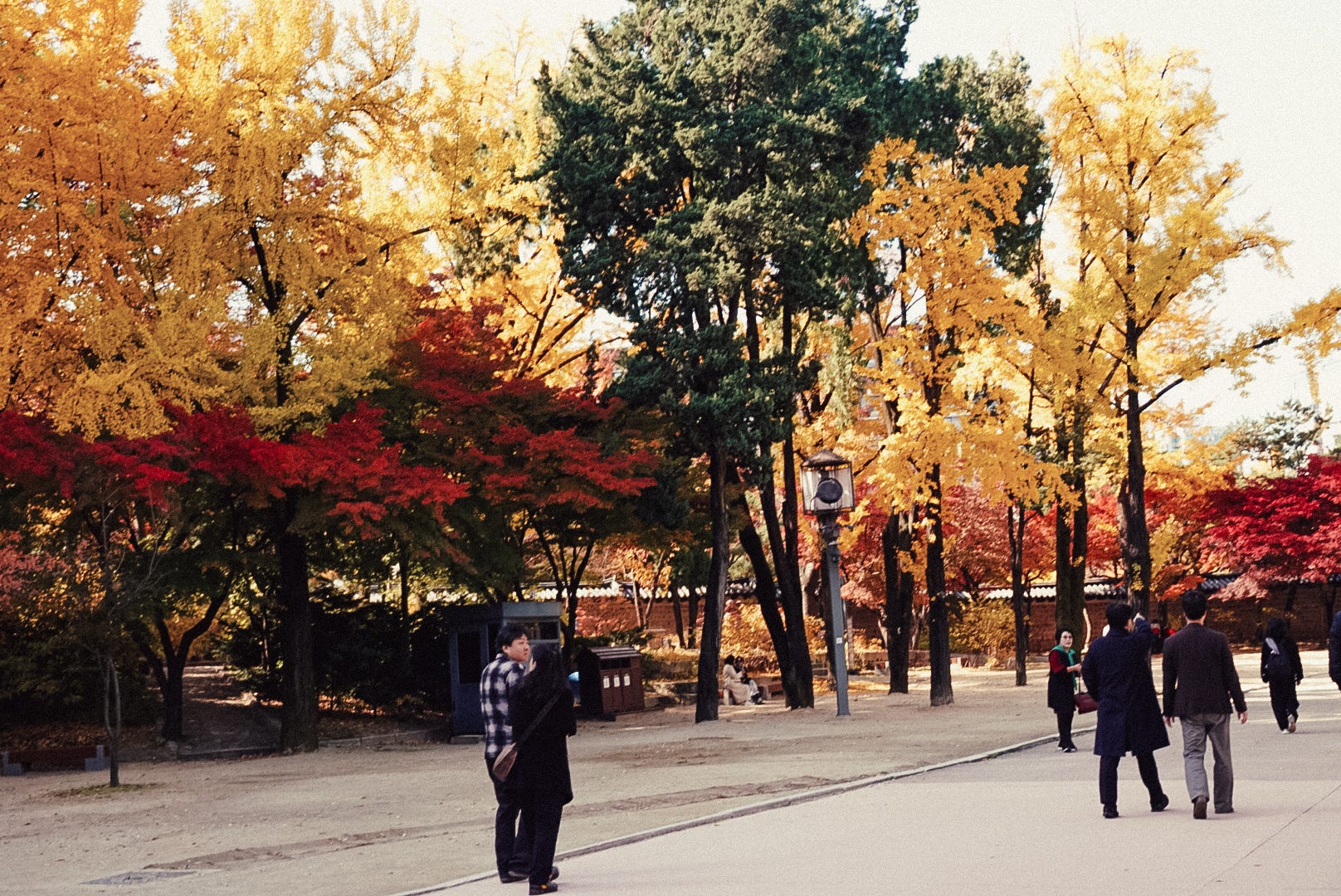
Going to Korea reminds me that I am well-loved.
My mother and I took our yearly trip to Korea at the beginning of November. I always look forward to this trip; it’s a chance to spend time with my favorite traveling partner, eat all the Korean food I can’t get in western North Carolina, and spend time doing girly things together without worrying about catering to my dad or partner. This time, in addition to Seoul, we visited Gyeongju and Busan, but we were really there for shopping and beauty.
Still, every time I go to Korea, I am reminded just how American I am. First of all, there is no psychic damage like clothes shopping in Asia.1 Second of all, I am constantly reminded of the difference in beauty standards. My mother and I got our seasonal color analysis done,2 and my preference is for more striking—even edgy and slightly androgynous—looks, but the analyst kept assuming I wanted to have “softer” or “more lovely” image. Frequently the point of contention seems to be my hair; it is thick and wavy, and I like wearing it natural.3 Yet on the occasions I do straighten it, I’m often told I look “younger” or “prettier” (i.e. more feminine) in Korea, whereas my wild waves usually get praised in America.
But the difference reveals itself in other, more subtle ways. I am fluent in Korean (although I am shy about speaking), but there are smaller, insignificant cultural nuances I’m simply ignorant of because I’ve never grown up with them. Fall is persimmon season in East Asia, and I love 홍시.4 One evening we went out to a crab dinner with one of my mother’s high school friends, and she gifted me some persimmons, but warned me that I couldn’t eat them for dessert. Apparently eating crustaceans and persimmons are a no, due to an old wives’ tale about the combination being lethal. (Supposedly a Korean king died after eating the two in short succession.) Other things like small puns escape me entirely, like how to pronounce the skincare brand SKIN1004.5
Yet despite this, there is an innate Koreanness to me that I cannot escape, despite being born and raised in the US. We had dinner with my relatives one night, and they lovingly made fun of me for having such traditional taste buds.
“It’s because you were raised by your grandmother,” they said.
It’s true my grandmother raised me, but she also raised my mother, who was born and raised in Korea, and our palates are not the same. I love Pyongyang-style 냉면,6 and even my yen for persimmons is considered hilariously old-fashioned. My mother loves burgers and French food, and her penchant for Western cuisine was evident in her ever since she was a child.
Yet despite the teasing, I was never subject to the backhanded, passive-aggressive compliments that are so prevalent in portrayals of Asian families. My grandmother, mother, and Korean relatives had always been unstintingly free with their praise and support. The first thing they said upon seeing me was “You get prettier every time we see you” and “Your face is still unchanged.”7 Perhaps this is because there is a part of them that still sees me as the little girl who came to live with them during summer vacations. I am something of the age-outlier when it comes to generations; there were fifteen years between my mother and my uncle,8 and my cousins are closer in age to her than they are to me.
But Americanness is catching too. My mother has been living in the United States for over forty years, and to my surprise, I’ve noticed that all her ejaculations and interjections are in English now. “Ouch!” and “Sorry” instead of a sibilant hiss or “죄송함니다.” She substitutes English words in Korean conversation, and sometimes she has to repeat herself to others. The Korean language, too, has drifted since she spoke it as a child. Elementary school is now 초등학교 (chodeung-hakyo) instead of 국민학교 (gukmin-hakgyo, or “citizen’s school,” as she grew up under a military dictatorship). In some ways, we are relearning Korea together every time we go back.
I can’t wait until next year.
In this issue
1. JJ’s magical world
2. Lexical gap
3. This creative life
4. What I’m reading
5. What I’m watching
6. Other things of note
lexical gap: 눈치 🧩
눈치 (pronounced nunchi) is an untranslateable Korean word that means anything from “common sense” to “reading the room.” It literally means “eye measure,” but it means being able to subtly navigate moods and contextual appropriateness. I think a lot about 눈치 when it comes to neurodivergence, and how often contextual understanding is written off as neurotypical thinking. Yet autistic and other neurodivergent people exist in Korea, but it doesn’t mean that they lack 눈치. Korea is an example of a high-context culture, and these nuances are collectively taught through interpersonal and community relationships. There is also more state support for neurodivergent individuals; my mother’s friend is a social worker, and she works with a single autistic person, for whom housing and other needs are provided. (Sadly, this person was essentially abandoned by their parents as an adult.) I think about this because America is a low-context culture, which tends to prize individualism over collectivism. We Americans look wistfully to South Korea’s recent impeachment of their last president and wonder why such things can’t happen here. Perhaps it is because we, as a culture, lack 눈치.
this creative life ✨
Progress on ROPE has been slow, but that is to be expected, considering the travel and the Thanksgiving holiday in the US. I think I’m at the point where I have all the pieces of the world that I need to tell the story I need to tell, and I have the structure of the plot, but what I lack are the plot happenings. This is the most frustrating part of my writing process that has remained through all six books I’ve written under contract; I know the shape of a story, I know the emotional turning points and the significance of certain events, but I don’t know what the event is. I always end up here, where I have the dollhouse and the dolls, but nothing for the dolls to do. There’s nothing for it but to grit my teeth, roll up my sleeves, and get my hands dirty, but as I have mentioned before, I loathe tedium. This is tedious. ㅠㅠ
So I’ve been thinking a lot about the voice and POV instead, because listening to someone’s voice is a lot more pleasurable to me than telling someone what to do. I think ROPE will be in first person, which I haven’t written in since Shadowsong, and I will admit to a bit of trepidation about returning to it. Liesl’s voice in Wintersong didn’t feel like I was writing so much as I was her amanuensis, the vessel for which her voice was made known. Thus far, ROPE’s protagonist has been quiet, although I can hear soft murmurs here and there. Of all my protagonists, Zhara was the hardest to get to know; in many ways, she is the most different from me, more inclined toward kindness and softness, but wrapped under layers and layers of protective reticence. It took me a long time to understand why: Zhara was abused by a parental figure growing up, so of course she wouldn’t open up to me straightaway. ROPE’s protagonist is similarly withdrawn, but for different reasons. Sometimes I just want to scream at them, “What’s your trauma?” so we can get it over with. But that is the way of writing sometimes. Sometimes the character just shows up and won’t shut up (Liesl, Han); other times, they need some wooing.
what i’m reading 📖
Tower of Thorns by Juliet Marillier. This is the second book of the Blackthorn & Grim series. I read the first, The Dreamer’s Pool, at the end of last month because I always turn to Juliet Marillier for a good slow burn romance. This series both is and is not what I thought it would be—a sort-of detective mystery series with the fey—but I do enjoy them. I found the “mystery” at the heart of this book more compelling than the first.
Den of Wolves by Juliet Marillier. The final book in the Blackthorn & Grim series. Phew, the burn is slower than Marillier’s other novels, almost too slow for my taste, and another one of my favorite detective series has a slow burn romance spanning eight books. I think the second book remains my favorite, although I think the third is better than the first.
Red City by Marie Lu. Biased because I love Marie, and I am from Los Angeles, but I thoroughly enjoyed this alternate fantasy LA and the childhood-friends-to-enemies-to-almost lovers storyline.
Dungeon Crawler Carl and Carl’s Doomsday Scenario by Matt Dinniman. This was a quick, enjoyable audiobook read while I spent an afternoon hyperfocused on building this book nook. It reminds me of Ready Player One, but more focused on the RPG aspect than the pastiche of 80s references. I was charmed by this, especially as an RPG player myself. It does, however, reveal the flaws of the LitRPG subgenre; it’s more a series of episodic battles than a story, but the voice was delightful and Princess Donut is the best. The performance by Jeff Hayes made this speed by.
“The Six Deaths of the Saint” by Alix E. Harrow. This short story genuinely cleansed my brain of algorithm-driven slop. I loved this. I feel like the less I tell you about this, the better. It’s available on Kindle Unlimited if you have it, and all I can do is encourage you to read it. I just started The Everlasting by the same author, which takes the premise and expands it into a novel, and I’m absolutely loving it.
what i’m watching 📺
The Secret Lives of Mormon Wives: Season 3. I normally don’t like reality TV shows (not even gentle competitions like The Great British Bake Off), but I remain sat for every episode of this. Perhaps it’s because my dad’s side of the family is Mormon (with a large population of the Rasmussens still in Utah) and the utter Mormon-ness of everyone is hilariously familiar to me. Taylor remains my favorite, and I understand why she wanted to swing with Miranda because, my god, she is so beautiful.
Frankenstein. Listen, I am going to biased. I love Guillermo del Toro’s oeuvre. This man gets me on a fundamental level. He is a gift to monster lovers everywhere. Is this the most faithful adaptation of the novel? (Of which there are two official editions.) No. I find the original more horror, but Guillermo del Toro, for all his love of the horror aesthetic, retains a romantic world view that I can’t help but respond to. Also, he revels in beauty and doesn’t care that it’s not naturalistic or logical. Someone please give Guillermo del Toro all the classic Universal monsters. I would watch every single one.
other things of note 💾
Canterel, Cy. “On Meaning and Antimeaning.” Abstract Machines, Substack, Nov 2025.
Alina. “Gatekeeping and the return of the literary SNOB.” According to Alina, YouTube, Nov 2025.
Callaghan, Ash. “The Modern Perfume Paradox and the Scent of Attraction.” ash callaghan, YouTube, Nov 2025.
Le, Mina. “You Don’t Need to Be Productive.” Mina Le, YouTube, Nov 2025.
Healey, Eugene. “Content is the New Pornography.” Considered Chaos, Substack, Nov 2025.
Yours entire,
I am a hair’s breadth away from being plus-sized and I am a US small or medium.
I am an ambiguous season lol. My best colors are equally distributed across Dark Autumn, Dark Winter, and Bright Spring.
Listen, my wavy hair journey took years, and I am finally at peace with it.
Pronounced hongshi, which is different from 단감 (dan-gam), or the Fuyu persimmon. When ripe, 홍시 is soft and intensely sweet.
SKIN1004 is Skin Cheonsa. I am so mad about this. How do I explain this pun. The word 천사 (cheon-sa) means “angel,” and the number 1004 (one thousand four) can also be read as 천 (1000) 사 (4), so the brand is literally Skin Angel. And here I was going around saying “Skin One-oh-oh-four” in both English and Korean.
Pronounced naeng-myun. It is a cold noodle soup with buckwheat noodles and beef broth. Nowadays 동치미 (dongchimi, or broth made from white kimchi) is added, which gives it a tangy and slightly sweet taste. I prefer it the way my ancestors from Pyongyang ate it: simple beef broth with a little bit of vinegar and hot mustard.
I know they say Asian don’t raisin, but I have been repeatedly told I have a youthful aspect and vibe. I was trying on some clothes in a modern hanbok store, and the saleslady kept bringing me things to wear, telling me that it was what the youth liked these days. When I told her I wasn’t a youth anymore, that I was, in fact, forty years old, she was shocked. “I thought you were my daughter’s 띠 (ddi, or age cohort),” she said. “She’s twenty-five.”
Due to two little events called World War 2 and the Korean War.